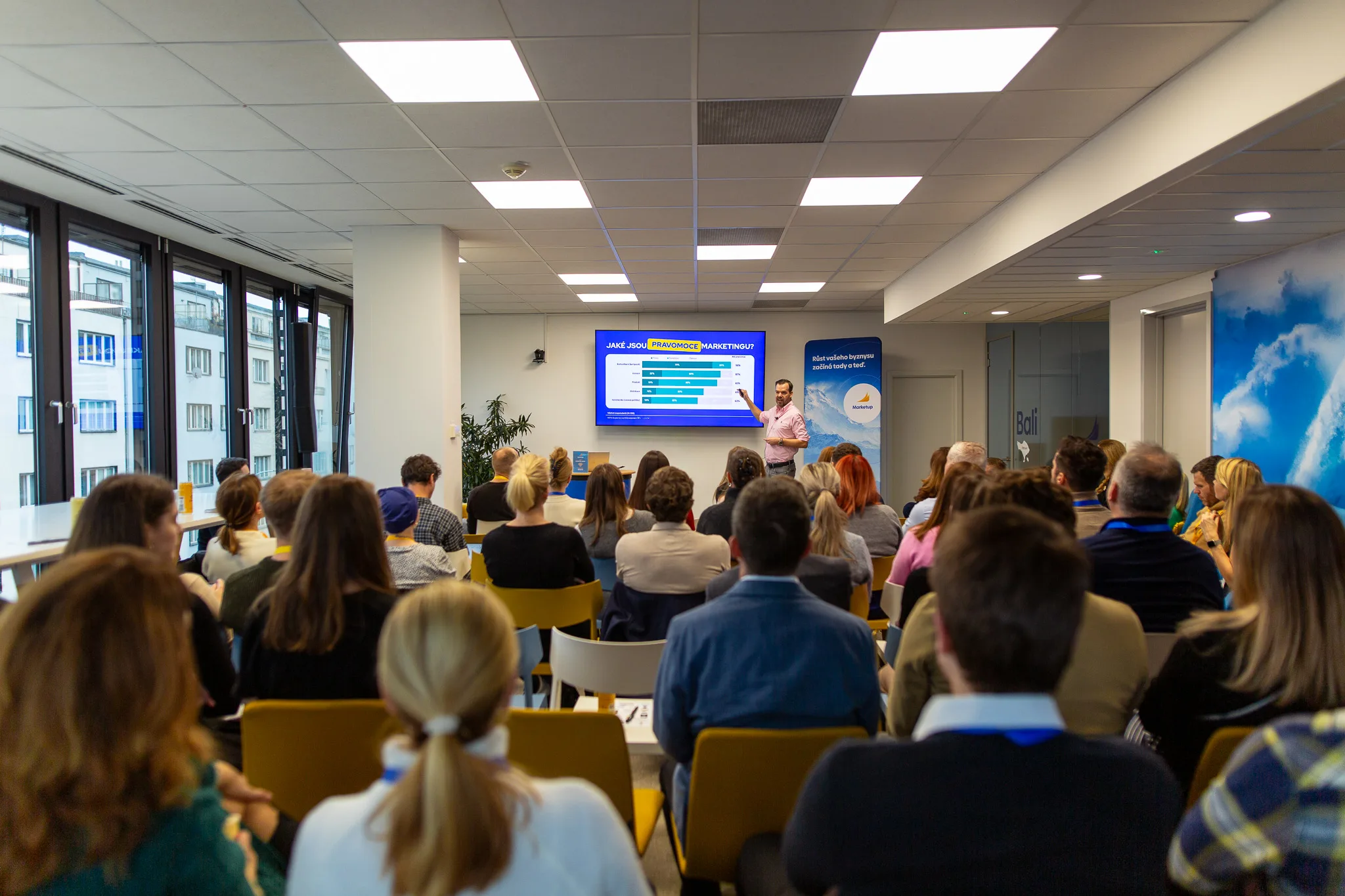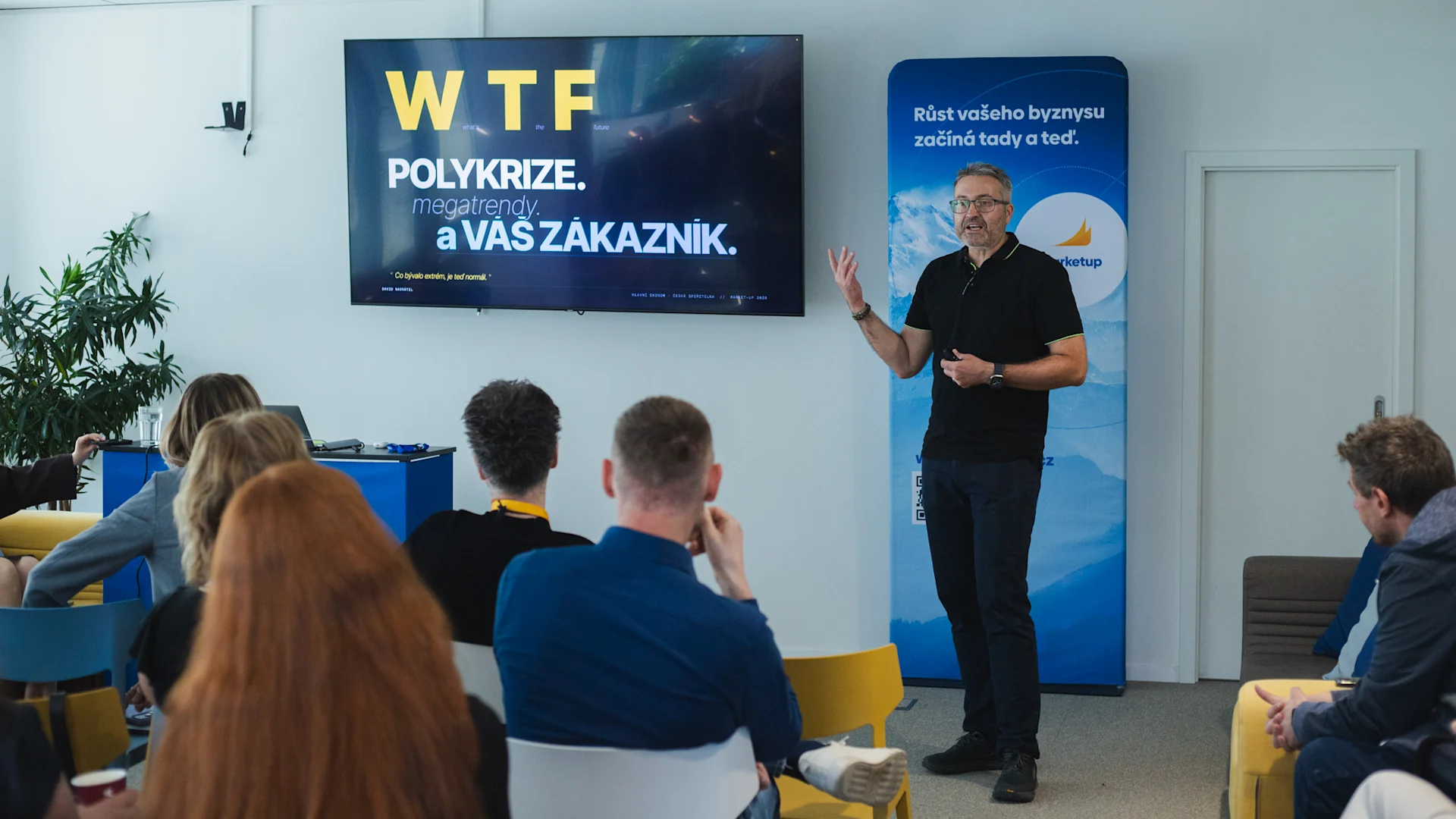

At our April Marketup Business Breakfast, we welcomed David Navrátil, Chief Economist at Česká spořitelna, as our guest speaker. He delivered a presentation that bridged the gap between the global economy and the daily reality of Czech businesses—moving beyond academic theory to focus on concrete data, trends, and the questions you must be able to answer. If you want to understand what is truly on your customers' minds today, read on for the six key takeaways from his presentation.
1. Polycrisis: A World Where Crises Amplify One Another
Our vocabulary is changing. Today, it’s not enough to monitor a single crisis—we live in the era of the polycrisis, a state where individual problems warp and amplify each other. The term was coined by historian Adam Tooze, and David Navrátil defines it simply: "A problem becomes a crisis when it challenges our ability to cope and, in doing so, threatens our identity."What does this look like in practice?
NATO’s Hedgehog 2025 exercise demonstrated how 16,000 soldiers from 12 countries were unable to effectively counter 10 Ukrainian drone pilots equipped only with laptops and Starlink.
The Strait of Hormuz: 33 kilometers of water through which 7% of the world's energy flows. Closing it would trigger a medicine and food crisis within 90 days.
Fertilizer blockades (Nitrogen -43%, Potassium from Belarus -66%, Phosphorus from China -98.6%) drove the price of urea up by 68%.
Distant geopolitical scenarios? No. This is the environment in which your customer shops and makes decisions every day.The current environment is no exception. According to the Modelski Cycle—a historical model of shifting global hegemons over the last 500 years—we are in the fourth phase: deconcentration and the dispersal of power. Sociologist Peter Turchin, in his book End Times (2023), adds an internal perspective: an oversupply of university graduates without adequate positions, a growing gap between expectations and reality (one in three graduates is now in the lowest income quartile), and state paralysis due to a failure to reform. External and internal pressures are hitting all at once. This is Polycrisis 2026.
2. Your Supply Chain Depends on 37 Points You Don't Control
The global economy has 37 strategic bottlenecks: 7 maritime (Hormuz, Suez, Malacca), 7 raw materials (lithium, graphite, rare earths), 6 digital (EUV machines, GPUs, undersea cables), 5 energy (LNG terminals, pipelines), and others. For Czech companies, 36% of GDP depends on these bottlenecks—spanning industry, defense, and engineering.Key insight: "The polycrisis will rewrite your own bottlenecks first. Before you can react, the impact will hit the customer." Companies that map their own dependencies before a crisis hits gain a massive competitive advantage. The rest will only see the impact on their P&L.
3. The Shifting Customer: From Community to Individualism
A fundamental shift in consumer behavior is also occurring, which David Navrátil describes as "From we to me." Customers have stopped trying to solve global problems and are focusing on their own lives, their own bank accounts, and their own peace of mind.Data from the 2025 Edelman Brand Trust Barometer is clear: 68% of customers want a brand to improve their mood, 62% want hope, and 59% want to learn something new. Altruistic communication like "help us save the planet" is losing traction. Although 75% of people fear the climatic future, 74% are struggling with inflation and 72% are stressed by monthly bills. The customer isn't asking, "What does this mean for the world?" They are asking, "What does this mean for me right now?"In this context, a quote from Milan Kundera resonated: REGRET: sadness + self-love + a sense of injustice + a suppressed desire for revenge. The result is "a state of torment created by the sudden sight of one's own misery."Seven out of ten people do not trust those with different values, and 40% (rising to 53% for the 18–34 generation) approve of hostile activism toward companies. A consumer who feels deceived actively seeks disruption: new brands, new channels, new authorities. And yet: trust in a brand that a customer personally uses remains at 80%. "Your brand is now a new institution of trust. And an institution carries responsibility," David Navrátil reminds us.

4. AI is Rewriting the Rules at an Unprecedented Speed
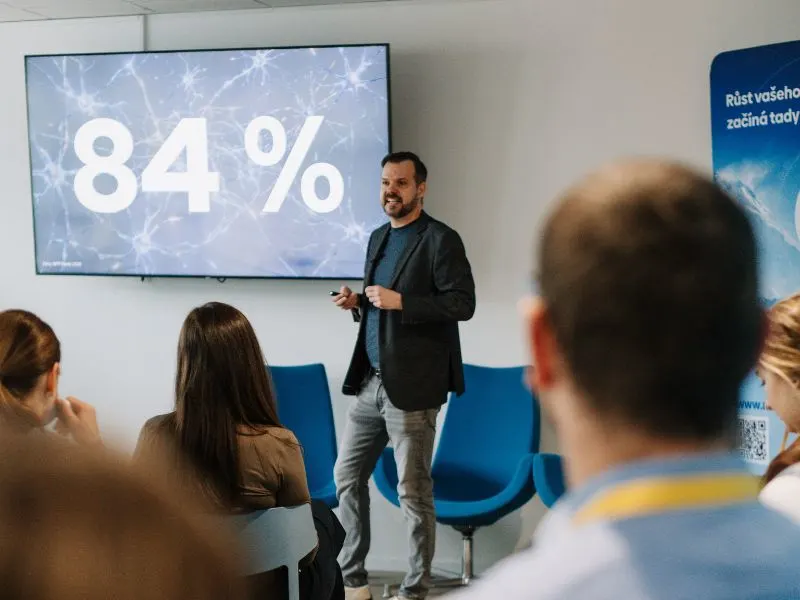
Generative AI achieved 53% adoption in just 2–3 years. The internet took more than 5 years to reach similar numbers; the PC took 17 years. The cost of tokens has dropped 280x in the last 18 months. Companies integrating AI report productivity gains of 21–40%, particularly in junior positions.But beware of the paradox: Gen Z—the generation with the highest adoption rate—also feels the greatest anxiety regarding AI. While 43% would trust AI to manage their money (compared to only 17% of Boomers), 38% fear the automation of their own jobs. Furthermore, 84% of AI developers actively use it, but only 29% truly trust it. Adoption must go hand in hand with critical thinking.
5. Your Target Audience is Being Redefined: Life Stage Over Age
By 2035, 25% of the EU population will be over 65—an increase of 17 million "silver ager" customers. For the Czech Republic, the longevity phenomenon has the potential to add +12% to GDP by 2040.David Navrátil pointed out a fundamental segmentation error: "Targeting does not equal age or generation. It is a life stage. A 70-year-old startup founder and a 55-year-old on parental leave are not the same segment." Opportunities are growing in health tech, longevity, and overall wellness, as well as senior housing, FinTech for the 65+, and multi-generational products. Those who ignore these customers today are ignoring the largest growing market segment.
6. Creativity is Not Decoration — And Three Questions to Move You Forward
According to research by Paul Dyson and System1, great creativity can multiply a company's profit by up to 12x compared to average creativity. Proper media mix optimization increases profit by 2.5x, and brands with recognizable assets grow 41% faster. "Creativity is not decoration. It is economic insurance." Moreover, in the era of polycrisis, the customer changes twice as fast. We must be one step ahead.To conclude his inspiring presentation, David Navrátil posed three questions that every marketer and business owner should ask themselves today:
Plan B: What happens to your brand if a key channel or supplier disappears today?
AI-Discoverability: Will ChatGPT or Perplexity algorithms find you when a customer searches for your category?
Adaptation Speed: Do you learn weekly, or only once a year?
The market will ask you these questions. The only choice is whether you will have the answer ready, or if someone else will dictate it for you. To help our clients find these answers, we have prepared a CMO Toolkit, where we address how to practically reflect this new reality in everyday work.

David Navrátil: A native of Ostrava and a graduate of VŠB-TU Ostrava. He began his career as an analyst at the Czech National Bank before moving to Česká spořitelna three years later, where he has served as Chief Economist since 2008. He specializes in macroeconomics, financial markets, megatrends, and prosperity. He is the co-author of the Prosperity and Financial Health Index. He is a regular media commentator and active on platforms such as X (Twitter) and LinkedIn. He also runs the Substack "Peníze, procenta a prosperita" (Money, Percentages, and Prosperity).
Download the free CMO Toolkit
Related articles