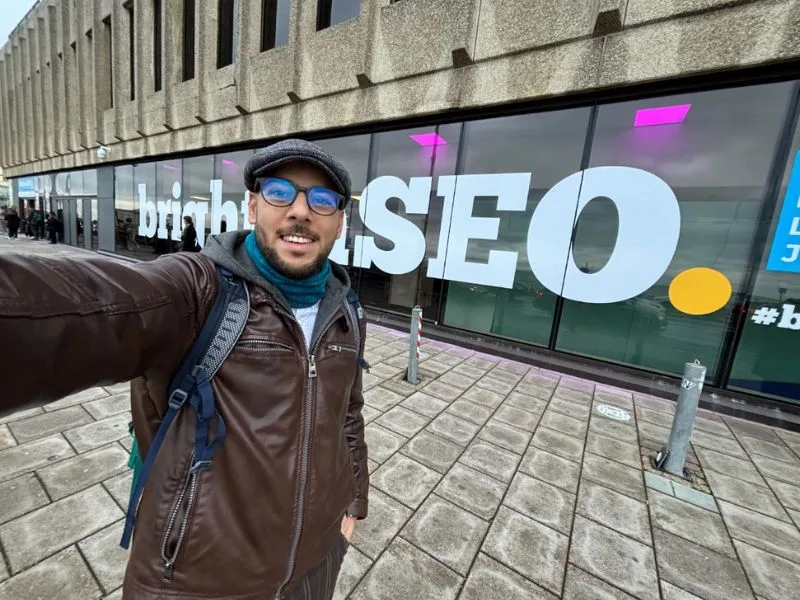

In October 2025, I traveled to Brighton, England, for the third time to attend what is, without exaggeration, the largest and best SEO event in Europe. The year 2025 proved to be a true turning point for our industry – AI Overviews arrived in Europe at full scale, and later that autumn, a new “AI Mode” in search was launched, fundamentally changing the way users consume search results.
While previous editions were marked by cautious experimentation, this year’s conference at the Brighton Centre delivered a clear message: the adaptation phase is over — the era of AI dominance has begun.
Traditional search is undergoing a transformation that Jack Lingard from the UK agency AIP Media compares to a “Kodak moment.” He refers to the historic mistake made by Kodak, which ignored the rise of digital photography for too long and clung to traditional film until the market ultimately left it behind. For Google — and for us as brands — this means one thing: either we fundamentally change our approach to optimisation and authority building, or we risk becoming irrelevant to the modern user.

Source: Jack Lingard, AIP Media
1. brightonSEO: 5,000 Specialists and the End of Linear Indexing
The brightonSEO conference has grown from an informal gathering of specialists in a local pub into a global epicentre of the industry — one that now helps shape the technological direction of modern marketing. This year’s edition attracted a record 5,000 attendees and more than 100 top-tier speakers from around the world. At the Brighton Centre, it was clear that the boundary between traditional search and AI has definitively disappeared.
In his keynote, Mike King, a respected technologist and CEO of the US agency iPullRank, declared that the era of linear indexing — crawl → index → rank — is over. It is being replaced by a model built on deep, real-time interpretation of context and user intent.
While Google still dominates the European market with billions of searches per day, the rapid rise of platforms such as ChatGPT — now handling around 185 million daily queries — is fundamentally reshaping the competitive dynamics of the search landscape.
2. SEO Terminology: A New Expansion Pack for a Game We’ve Been Playing for 20 Years
The industry is currently buzzing with acronyms like GEO, AIO, LLMO, or AEO. In reality, however, the label doesn’t matter that much. At its core, it’s still about one thing: optimising websites and brands for the modern digital ecosystem. Good old technical SEO remains a mandatory foundation, but AI has added a new — and far more complex — layer on top of it.
To make this easier to understand, I often use a gaming analogy. Imagine SEO as a game we’ve been successfully playing for 20 years. Suddenly, a massive expansion pack (AI) is released. The core game remains the same, but new features, mechanics, and vast new environments are added. If you don’t start using them, your competitors will eventually leave you behind. In short, GEO is essentially SEO on steroids.
As James Hocking, Director of Hocking Digital, put it succinctly: 48% of LLM searches are sourced directly from websites, while the rest are based on proprietary databases where AI models learn from their own data. These sources include mentions, citations, references, rankings, and other authority signals.

Source: Hocking Digital, James Hocking
3. How AI Really Helps: The Specialist as a Curator of Context
Many people fear that AI will start writing content for them and that SEO specialists will become obsolete. The reality is quite the opposite. Don’t worry — SEO is far from dead. While AI can generate content at an unprecedented scale, it fundamentally lacks context and deep business understanding — and that is precisely where our role comes in. Tom Vaughton, founder of VARN, warned against what he calls the “trap of mediocrity.” If you let AI create content without human guidance, the result will be nothing more than generic, average output — content that search engines will quickly stop valuing.

Source: VARN, Tom Vaughton
Where Does AI Truly Help Us in 2026?
Semantic research: Lazarina Stoy from MLFORSEO explained that we are no longer searching for keywords, but for concepts relevant to the brand — with a deep understanding of user intent and the appropriate information format.
Intent analysis: Ulduz Ismayilova from GeoPostcodes demonstrated how AI can analyse thousands of keywords in seconds and accurately determine what users truly expect — for example, a product page instead of a blog article.
Hallucination detection: Charlie Morley-Harman from the UK-based Sitelogic Digital presented automated scripts designed to monitor whether AI systems are fabricating false or misleading information about your brand.
Vector semantics: Frank van Dijk from the agency DEPT explained that AI perceives your website as numbers within a vector space. Our task is to provide machines with context through semantic content connections — context that would otherwise remain misunderstood or completely invisible.
4. Cross-Channel Marketing: SEO No Longer Plays Solo in Silence
The customer journey has long since stopped being linear. In the UK market — which often foreshadows developments in our region — consumers now typically switch between five or more devices before making a purchase decision. That’s why at Marketup, we never view SEO in isolation.
Charlie Clark from Minty Digital presented data that will be critical in 2026: 96% of citations in AI-generated answers come from PR content (earned media), not directly from brand websites. This is further reinforced by Ashley Liddell from Deviation, who emphasised that a brand must exist everywhere culture lives.

Source: Deviation, Ashley Liddell
In 2026, an SEO specialist must work closely with PR, PPC, and social media teams to collectively build unquestionable authority across all channels — the so-called Search Everywhere Trifecta.
5. Google for Keywords, AI for Dialogue. And What About Gen Z?
The way people search has changed dramatically. While we still tend to use short, fragmented queries in Google (such as “cheap flights”), prompts in AI tools are on average 10× longer and take the form of full sentences or even a dialogue. Users now share personal context and real-life details with search tools in order to receive more personalised, relevant answers.

Source: iDHL, Chris Walch
An even more significant shift can be seen among Generation Z. For them, Google is often no longer the first choice — they search on TikTok and Instagram through video-based content instead. Cristiano Winckler from Somebody Digital highlighted the reality of the UK market: 58% of searches now end without a click (zero-click searches). Users receive answers directly within AI-generated summaries and never actually reach your website. The presence of AI Overviews further reduces the click-through rate (CTR) of the first organic position by a staggering 34.5%.
6. Content Is King — But Only with Proven E-E-A-T
We can no longer afford to produce “content for the sake of content.” The key to survival lies in E-E-A-T (Experience, Expertise, Authoritativeness, Trustworthiness). Rich George from Wavemaker defined the term “Content Decay” as a silent threat to website performance. If content is not regularly updated and enriched with genuine human experience, AI-powered search engines will simply stop citing it.

Source: Wavemaker/WPP, Rich George
For 2026, I therefore recommend implementing the Keep, Kill, Merge, Refresh framework. You must become a curator of your own content and decide every quarter what still delivers value and what has become dead weight. Remember: for modern search systems, data freshness is synonymous with visibility.
7. Agentic Commerce: When a Machine Shops on Your Behalf
This vision — already emerging in the UK and the US and gradually making its way to Central Europe — is known as Agentic Commerce: an era in which the purchasing process is delegated to autonomous AI agents. Killian Dunne, founder of the UK startup Telepathic, outlined a future where tools such as Google Project Mariner or Perplexity Buy with Pro compare parameters, read reviews, and complete purchases entirely on behalf of the customer.
Visitors who arrive on websites from AI-powered search already show 3–8× higher conversion rates than traditional Google traffic. Why? Because the hardest part of the decision-making process has already been done by the bot. For e-commerce businesses, the implication is clear: product detail pages (PDPs) must be perfectly machine-readable. Abbie Dando from Monday Clicks demonstrated how AI can be used to scale PDP optimisation and save up to 15 hours of work per week.
8. Technical SEO: The 130-Day Rule Is an Unforgiving Verdict
This was the moment in Brighton that got every core SEO specialist out of their seat. Adam Gent from Indexing Insight revealed how Google actually manages its index. Based on an in-depth study of 1.4 million pages, he found that 86% of non-indexed URLs are rejected due to low quality — not technical errors.

Source: Indexing Insight, Adam Gent
And now the most important part: Gent defined the 130-day rule. If Googlebot does not visit your page for 130 days, the system actively removes it from the index as irrelevant. After 190 days, the search engine effectively “forgets” the page altogether, and it loses all priority for future crawling. Internal linking and content quality are no longer just best-practice recommendations — they have become an existential necessity if you want to remain indexed at all.
9. Management and ROI: Marginal Returns as the Holy Grail
The conclusion belongs to the numbers that truly matter to company leadership. Antonio Lima, VP of Data at WeDiscover, explained why focusing solely on average ROAS (return on ad spend) can be misleading. Marginal ROAS (mROAS) reveals whether each additional unit of budget actually generates incremental profit or whether you are simply burning money in increasingly inefficient campaigns.

Source: WeDiscover, Antonio Lima
Add to this the challenge of Dark Social. Stephen Akadiri from Grey pointed out that as much as 56.5% of content sharing happens in private channels such as WhatsApp and Slack - which Google Analytics then attributes as “Direct” traffic. SEO specialists therefore need to learn how to measure these “dark” conversions - for example using UTM parameters and QR codes — in order to defend the channel’s real revenue impact to company leadership, as advised by Jack Kennedy from Invanity.
10. Key SEO Takeaways for 2026
A successful strategy for the year ahead cannot exist without the following steps:
Build entity authority (Brand Authority): AI recommends brands it trusts. A strong reputation demonstrably increases shareholder value by 31%.
Structure content for machines (Machine Readability): Implement flawless structured data (Schema.org), FAQs, and semantic markup — otherwise AI shopping agents will simply skip you.
Diversify traffic sources (Traffic Diversification): Don’t rely solely on Google. Be present wherever people search — from Reddit and TikTok to Perplexity and ChatGPT.
Fight content decay (Content Decay): Regularly audit your website using the Keep, Kill, Merge, Refresh framework. Data freshness is critical for AI citations.
Monitor crawl frequency (Crawl Prioritisation): Remember the 130-day rule. If Googlebot hasn’t visited a page in a long time, it is at risk of being removed from the index.
Measure real profitability (Marginal ROAS): Identify the point where investment turns inefficient and optimise for profit — not just traffic volume.
Uncover invisible traffic (Dark Funnel Tracking): Track conversions from private channels using UTM parameters and dedicated landing pages.
Unify channels into the Search Everywhere Trifecta: Connect SEO, PR, and social media. AI models recognise harmony — not isolated efforts.
The future of search belongs to those who stop merely “chasing rankings” and instead become an undeniable authority across the entire digital ecosystem. If you’d like to turn these Brighton insights into real growth for your business, I’d be happy to discuss concrete next steps over a good cup of coffee...☕️
Acronym Glossary
SEO (Search Engine Optimization): Traditional optimisation for classic search engines (e.g. Google, Seznam, Bing).
GEO (Generative Engine Optimization): Optimisation for generative search engines and AI-powered tools (e.g. ChatGPT, Perplexity).
AEO (Answer Engine Optimization): Optimisation focused on becoming the direct answer provided by search engines (Featured Snippets, AI Overviews).
LLMO (Large Language Model Optimization): Optimising how a brand is perceived and represented by large language models.
E-E-A-T: Experience, Expertise, Authoritativeness, Trustworthiness — core quality evaluation factors used by modern search systems.
mROAS (Marginal Return on Ad Spend): The profitability of the last incremental unit of advertising investment.
PDP (Product Detail Page): A detailed product page within an e-commerce website.
Dark Social: Traffic originating from private channels (messaging apps, emails) that standard analytics tools cannot directly attribute.
Related articles